Give the research hours back
Somebody on your team is clicking through agendas, PDFs and portal after portal to work out what is moving. That is the job this replaces — and it is a salary doing it, not a subscription.

Preconstruction intelligence for general contractors
For the general contractor who wants a project before it goes out to bid — and the civil engineers, surveyors and sitework crews who move first on it. By the time a permit issues, the work is usually spoken for. CivilSpotter follows a project from its first public filing through permit and construction, and shows you the parties named on its filings, in the role each filing gives them. Every fact carries its source, so you can check the work.
Available now: the Austin metro area.
Built on the public record. Every figure in the product carries its source. Or book a demo.
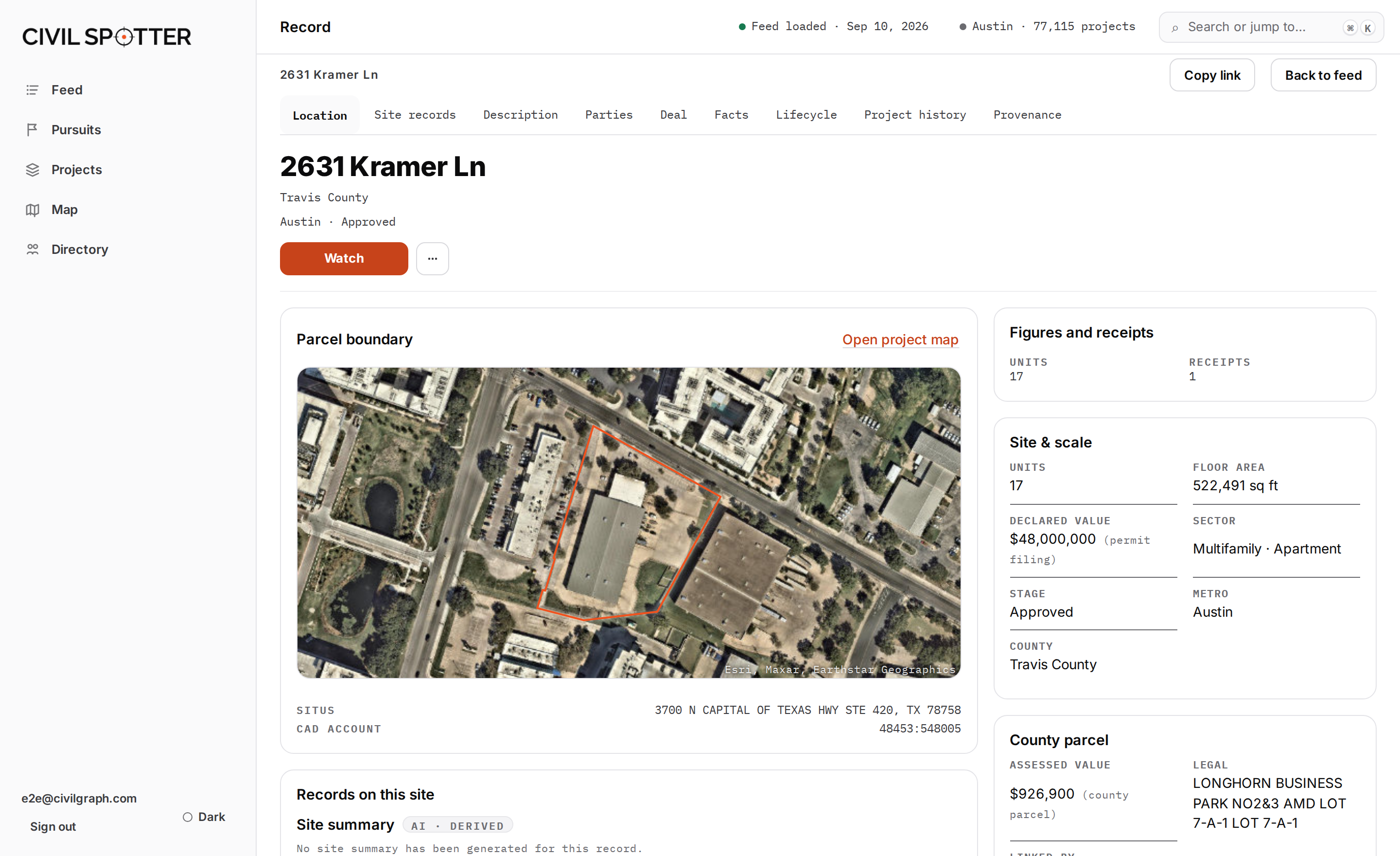
A real Austin record, captured 10 September 2026. Its stage may have changed since.
The problem was never a shortage of public data. It is finding the project while there is still time to act on it.
Somebody on your team is clicking through agendas, PDFs and portal after portal to work out what is moving. That is the job this replaces — and it is a salary doing it, not a subscription.
Every jurisdiction we cover in your market, read the same way, which is not a thing a person or a small team can keep up by hand. Where a jurisdiction is not covered yet the product says so rather than implying it is — so less live work goes past you, and fewer of the jobs you chase turn out to be gone.
Who is named on a project's filings, and in what role — assembled for you rather than by someone billing hours for it. It is the same public record either way; this just puts it in reach of the contractors who actually build the work.
Screenshots of the Austin board, captured 10 September 2026. Nothing here is a mockup; what each frame shows may have changed since.
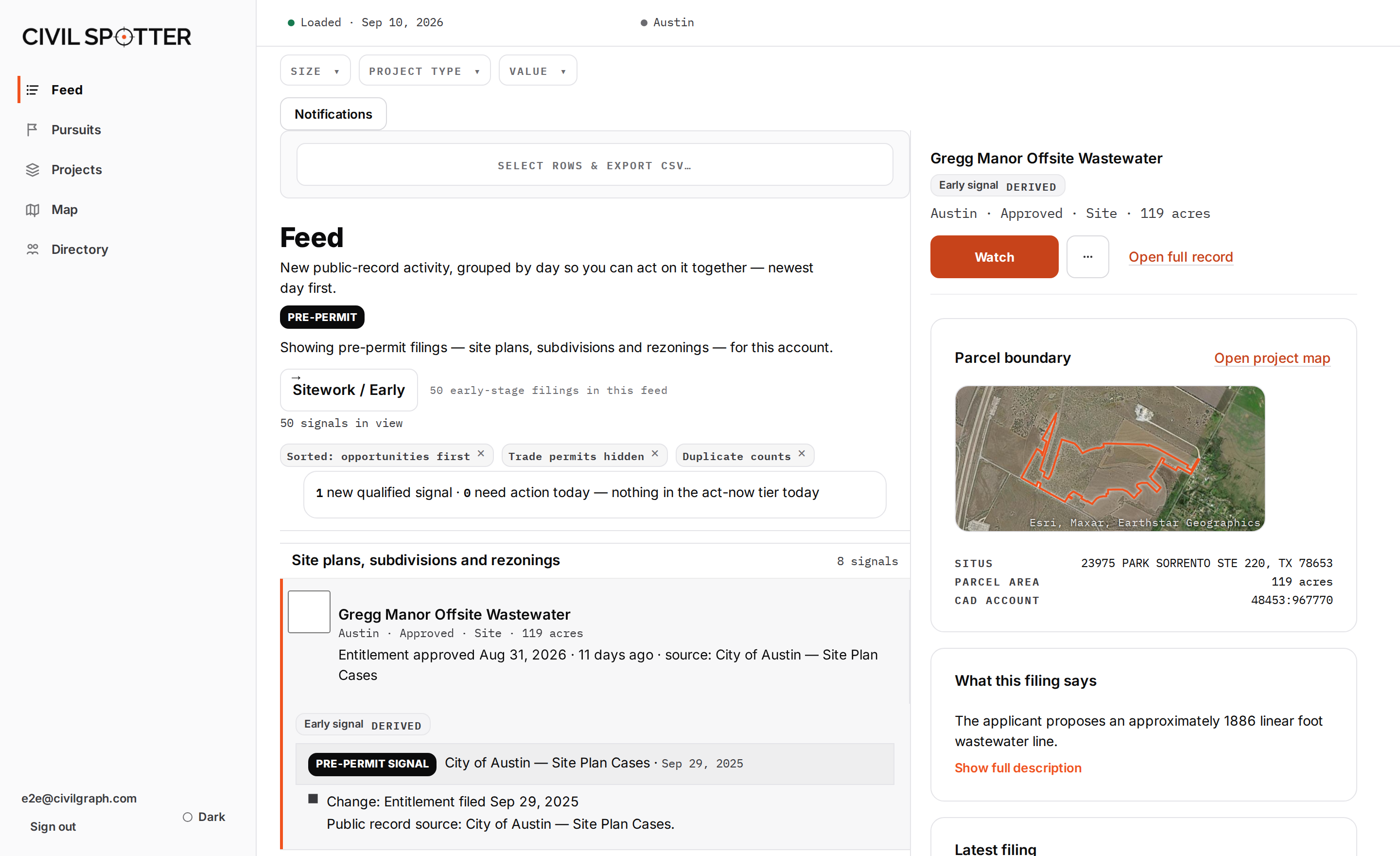
Filings arrive grouped by the day they surfaced. Each row already says what changed, how far along it is and how big — so the scan is the work, not the setup for it.
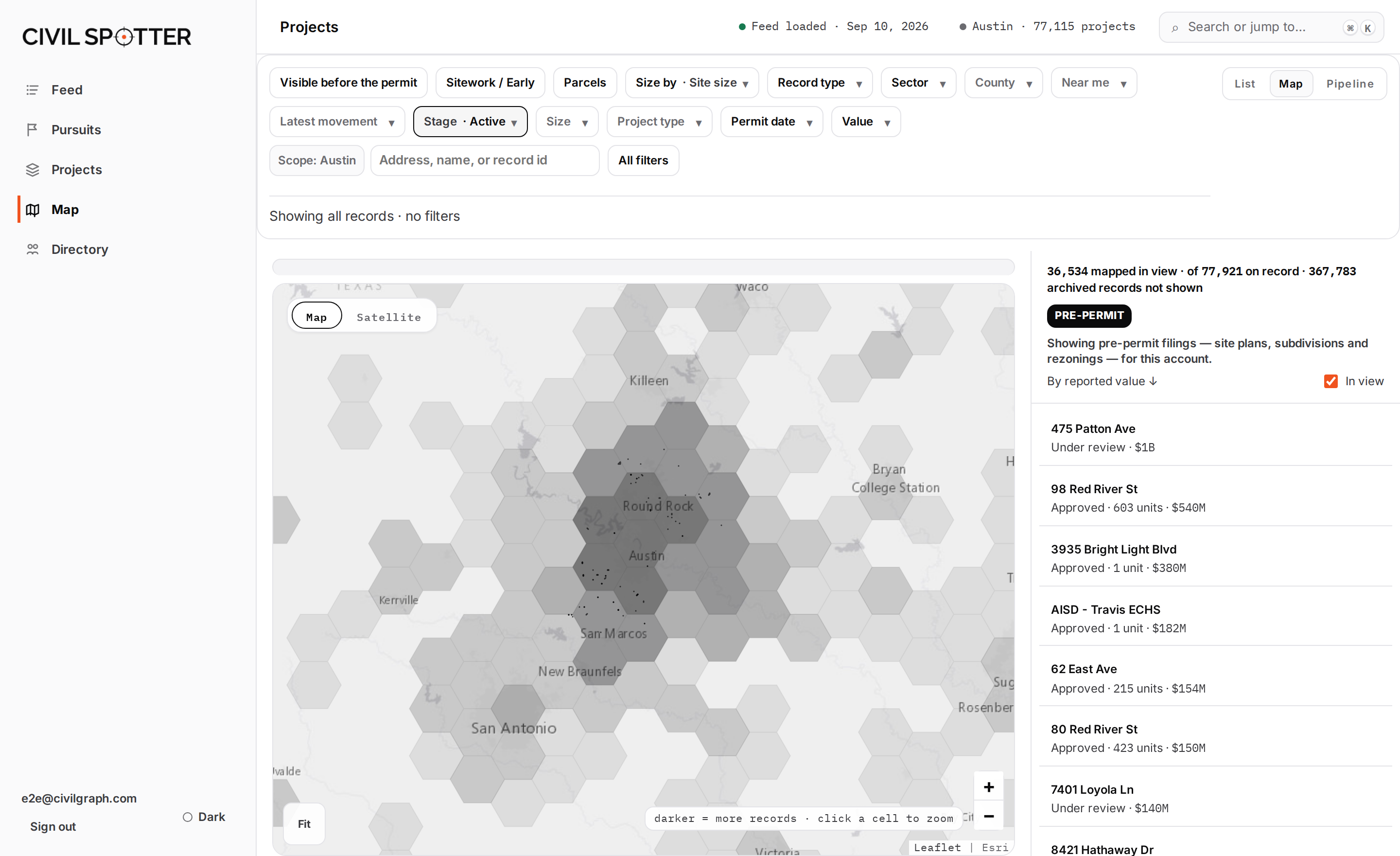
A deliberately quiet basemap so the data is the only thing competing for attention. Across a metro the map groups active work into counts you can read at a glance; zoom into a territory and each mark is sized by site acreage — the earthwork opportunity — so the biggest job is the one that looks biggest. Records with no measured size are drawn as an outline rather than guessed at.
No integration, no data project. You pick a market; the record does the rest.
Site plans, subdivisions and rezonings are pulled as jurisdictions publish them, normalised into one vocabulary so a suburb filing reads the same as a downtown one.
Every figure on a record is stamped with where it came from and when it was last seen. Where the record is silent, the product says so instead of guessing.
Filtered to your trade and territory, ordered by what moved most recently, with the named party on the filing where the public record carries one.
Knowing a project exists is the easy half. Knowing which parties its filings name, and the role each filing gives them, tells you who you could ask about it.
Each link means a party is named on that filing, in the role the filing gives it, so every link traces back to a document. Being named on the same filing does not show who hired whom. In the Austin product this surfaces as the named parties on each record and the company directory for the market.
CivilSpotter keeps the states the record shows a project has been in — what moved, when, which document caused it, and who appeared along the way.
Those are four of the tabs on a real record, not a description of them — which is the point of the last one. You are not asked to take our word for it: the Provenance tab names the sources the record was built from and when it was last read, so you can go and check.
Each card shows what the record held when it was read. Stages are as of that read, not today — sign in for the current record.
Tell us where you build. Which market opens next is decided by who is asking for it — so this is the vote, not a mailing list.
The coverage we can stand behind, named plainly — what the record actually holds today.
The Austin metro area, in one record set and one vocabulary. We state the market we cover, not a state we imply.
Where a jurisdiction's feed is current, updates land the day its sources publish; where one has fallen behind, the product flags it rather than showing it as current. Every figure carries the date it was last read.
We are not quoting a project count yet. The Austin record is still being consolidated, and a headline number we would have to walk back is worth less than one we publish when it is true.
Priced per market and per seat. We quote it on the call, once we know what you cover.
See it against your own market first. If the earlier signal is not there, there is nothing to buy — we would rather show you than pitch you.
We are onboarding a founding cohort of five companies, so that coverage is proven in the market before it is sold.
Book a demo for pricingThe product serves the Austin metro area today. It states its own coverage plainly, rather than implying it is uniform.
It depends on the jurisdiction and the project. A site plan or subdivision case is filed and heard well before a building permit issues, so the lead time is the gap between those two events — which the record itself shows you, project by project.
A permit feed tells you a decision already happened. CivilSpotter tracks the filings that precede it and the parties those filings name, so you can follow a project before its building permit issues.
A maintained register of public-record sources, normalised into one project vocabulary and resolved to companies. Every figure in the product carries the source it came from and the date it was last verified.
Trusted by